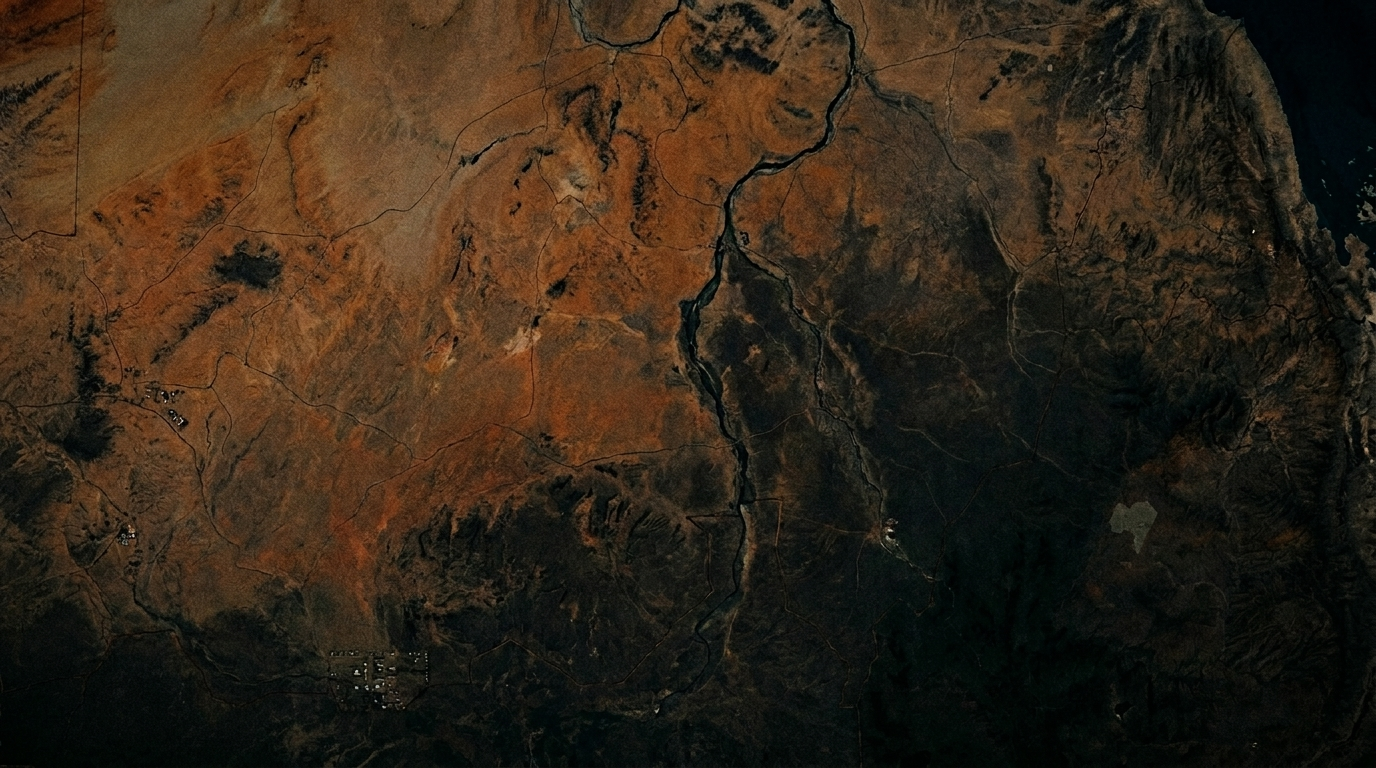
STRATEGIC OVERVIEW
Sudan's internal conflict has evolved beyond a domestic power struggle into a regional destabilization crisis. The war between the Sudanese Armed Forces (SAF) and the Rapid Support Forces (RSF) has fragmented the country's territorial control and triggered cross-border insecurity, arms flows and humanitarian collapse.
By 2026, Sudan functions as a multi-theater conflict zone, where frontlines shift rapidly and authority is decentralized. The absence of a unified state structure has allowed armed groups, tribal militias and external actors to expand influence. Neighboring states — particularly Chad, South Sudan, the Central African Republic and Libya — are increasingly affected through refugee influx, smuggling routes and security spillovers.
The conflict has become one of the most consequential security shocks in Africa in a generation, with implications that extend across the Sahel, the Red Sea corridor and the wider Horn of Africa.
THREAT VECTOR ANALYSIS
Cross-Border Militia Movement
Armed groups operate across porous borders, particularly into Chad and South Sudan. These movements:
- Extend Sudan's conflict dynamics beyond national territory.
- Increase inter-communal violence in border regions, including Darfur and Abyei.
- Complicate regional security coordination among already fragile states.
Arms Proliferation
The breakdown of central authority has enabled large-scale weapons circulation:
- Light and heavy weapons moving through Sahel and Libyan routes.
- Increased availability to non-state actors and tribal militias.
- Strengthening of insurgent and trafficking networks across borders.
Humanitarian Spillover
Millions of displaced civilians have crossed into neighboring countries, creating:
- Severe resource strain in already-fragile states such as Chad and South Sudan.
- Refugee camp instability and recruitment exposure.
- Expanded recruitment pools for armed groups and trafficking networks.
External Involvement
Regional and international actors are indirectly involved through:
- Political backing for one side or the other.
- Arms transfers and financing channels.
- Strategic positioning along the Red Sea coast and gold-producing areas.
This transforms Sudan into a proxy-influenced conflict environment, where the war's outcome is shaped as much by external sponsorship as by the parties on the ground.
MILITARY POSTURE
The conflict is defined by fragmentation rather than conventional warfare:
- SAF controls parts of urban centers, key infrastructure and the Red Sea coastal belt.
- RSF maintains mobility and influence in western and central regions, including much of Darfur.
- Local militias operate autonomously with shifting loyalties.
Neither side has achieved decisive dominance, resulting in:
- Prolonged attrition warfare.
- Urban combat that destroys critical infrastructure.
- Decentralized operations across multiple disconnected fronts.
OUTLOOK
Sudan is likely to remain a persistent regional instability hub. Key developments to monitor:
- Expansion of conflict into neighboring territories, especially Chad and South Sudan.
- Increased coordination — or further fragmentation — among armed groups.
- Escalation of external actor involvement and arms flows.
- Intensification of the humanitarian crisis and famine risk in Darfur.
A unified political resolution remains unlikely in the near term.
"Sudan's conflict is no longer contained — it is a regional destabilization engine, linking North Africa, the Sahel and the Horn of Africa through interconnected security threats." — Based on UN, Reuters, BBC and ICG reporting.
OUTLOOK SUMMARY
Sudan in 2026 functions less like a single civil war and more like a continental flash point — exporting weapons westward into the Sahel, refugees southward into Chad and South Sudan, and instability eastward toward the Red Sea. Until either side breaks through militarily or external sponsors converge on a settlement, the spillover will continue to define the security environment of an entire region.
FREQUENTLY ASKED QUESTIONS
What is causing the civil war in Sudan?
The conflict is driven by a power struggle between military and paramilitary forces competing for control of the state.
Who are the main factions fighting?
The primary actors include national armed forces and rival paramilitary groups with significant military capacity.
Why has the conflict escalated rapidly?
Breakdown of political agreements and competition for power have intensified fighting. This has led to widespread instability.
How severe is the humanitarian crisis?
The crisis is severe, with large-scale displacement and disruption of essential services. It is considered one of the major humanitarian concerns globally.
Which cities are most affected by fighting?
Major urban centers and strategic regions experience the highest levels of conflict intensity.
Is there any path to ceasefire?
Ceasefire efforts exist but remain fragile and difficult to sustain due to ongoing hostilities.
AUTHOR
Arda Alkis is an energy and hybrid conflict analyst specializing in maritime security, strategic chokepoints, and irregular warfare. His work is based on open-source intelligence and data from ACLED (Armed Conflict Location & Event Data), the International Crisis Group (ICG), and international reporting networks. He focuses on energy-driven conflicts, proxy warfare, and instability across the Middle East, Africa, and global trade corridors.
Read more about the WarWatch editorial team on the About page.
SOURCES AND REFERENCES
- ACLED (Conflict Data)
- United Nations OCHA
- International Crisis Group (ICG)
- Reuters – Africa
- BBC News Africa
TRACK SUDAN AND HORN OF AFRICA DEVELOPMENTS IN REAL TIME
⊙ OPEN LIVE MAP