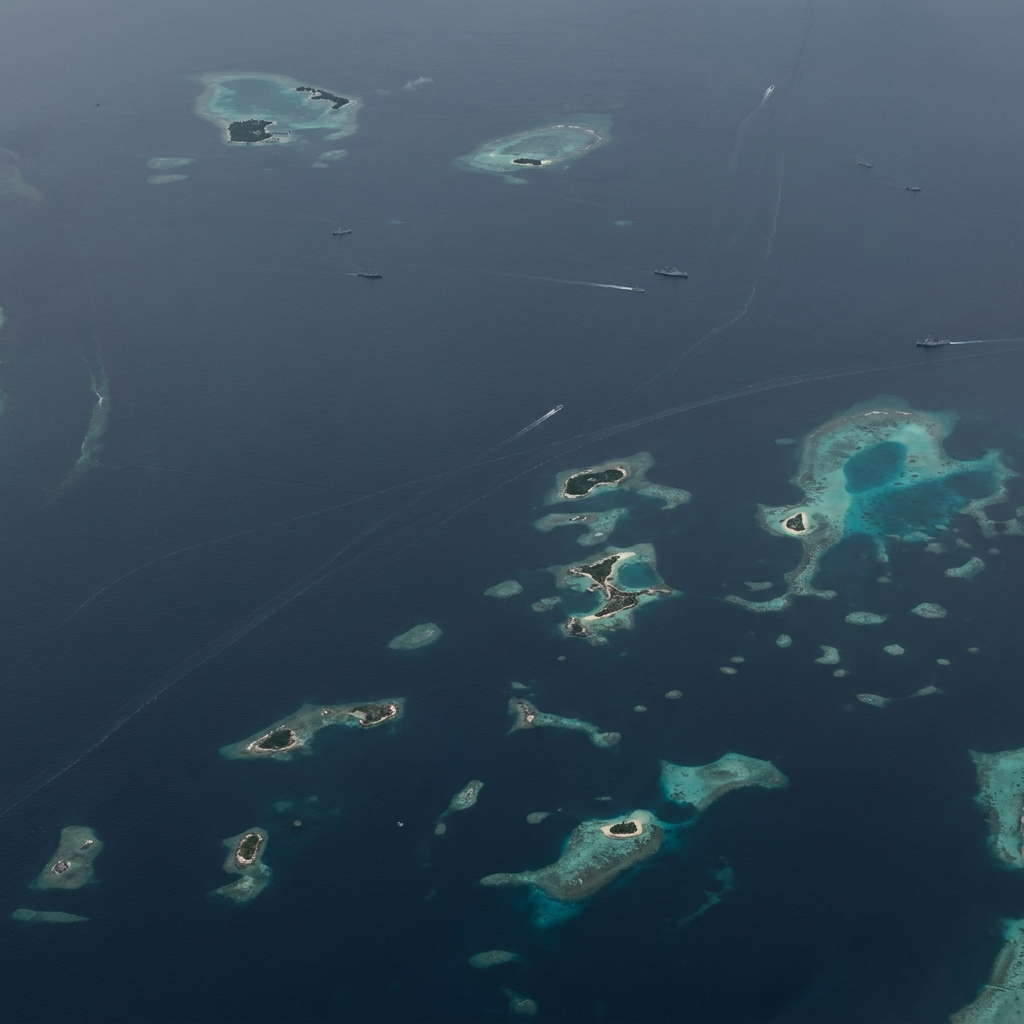
STRATEGIC OVERVIEW
The South China Sea dispute in 2026 remains one of the most volatile maritime flashpoints globally. At its core lies a structural conflict between China's expansive territorial claims and regional resistance led by the Philippines, with the United States, Japan, and Australia increasingly aligned in the background.
Recent developments show a shift from direct naval confrontation to hybrid conflict methods, including intelligence operations, maritime militia harassment, and strategic disruption of resupply missions. Despite the absence of large-scale clashes, tensions remain persistent and structurally embedded.
The strategic importance of the region extends well beyond the disputed reefs and shoals: roughly one-third of global maritime trade transits the South China Sea, and the surrounding waters underpin energy security across East Asia.
THREAT VECTOR ANALYSIS
Maritime Confrontations
Chinese coast guard and maritime militia continue to challenge Philippine resupply missions, particularly around Second Thomas Shoal. Tactics include water cannon use, dangerous maneuvering, and physical blocking of small vessels — calibrated to apply pressure without crossing into clear armed conflict.
Intelligence and Espionage
A confirmed intelligence breach has exposed Philippine operations, allowing Chinese forces to anticipate movements at sea — a notable escalation in hybrid warfare. The incident underscores that the modern phase of the dispute is fought at the intersection of maritime, cyber, and human intelligence domains.
Legal vs Physical Control
While the 2016 Permanent Court of Arbitration ruling rejected China's sweeping nine-dash line claims, Beijing maintains de facto control through continuous presence, infrastructure construction, and persistent enforcement actions against rival claimants.
Strategic Chokepoint Control
The region is critical for global shipping routes and energy flows, increasing its geopolitical significance and turning every minor incident into a marker for the wider US–China contest in the Indo-Pacific.
MILITARY POSTURE
China maintains a layered maritime strategy:
- Coast guard — grey-zone enforcement under a non-military legal cover.
- Maritime militia — deniable operations with civilian fishing vessels.
- PLA Navy — deterrence backbone behind both layers.
The Philippines, backed by the United States, relies on:
- Limited naval capability concentrated on territorial defense.
- Strategic alliances — Mutual Defense Treaty with the US, expanding access agreements.
- Legal frameworks and international advocacy.
However, ASEAN divisions weaken a unified regional response, and a fully coordinated multilateral pushback against Chinese activity has not materialized.
OUTLOOK
Future developments are likely to include:
- Increased hybrid operations — espionage, harassment, and information warfare.
- Continued militarization of artificial islands and outposts.
- Rising US involvement, including expanded freedom-of-navigation operations and joint patrols.
- Greater integration of Japanese and Australian naval activity in the broader theater.
A full-scale war remains unlikely, but constant low-level escalation will define the region for the foreseeable future.
"The South China Sea conflict is not about immediate confrontation, but the gradual normalization of control. The real risk lies in incremental escalation crossing a red line unexpectedly." — Based on Reuters, BBC, and security studies reporting.
OUTLOOK SUMMARY
The South China Sea is not a region drifting toward war so much as a region drifting toward permanent contestation. Each year of grey-zone activity reinforces Chinese de facto control while incrementally reducing the political and operational room available to Manila and its partners. Without a structural shift — diplomatic breakthrough, decisive ASEAN consolidation, or a major incident that changes the calculus — the trajectory points to an indefinite low-temperature standoff.
FREQUENTLY ASKED QUESTIONS
What is happening between China and the Philippines in 2026?
Tensions have intensified due to repeated maritime encounters and competing territorial claims. Incidents involving coast guard and naval vessels have increased in frequency.
Why are tensions rising in the South China Sea?
The region is contested due to overlapping sovereignty claims, strategic shipping routes, and resource access. These factors continue to drive long-term geopolitical friction.
How are territorial disputes escalating in the region?
Escalation is occurring through increased patrols, infrastructure development, and direct confrontations at sea. These activities raise the risk of miscalculation.
What role does the US play in supporting the Philippines?
The United States provides security cooperation, including joint exercises and strategic deterrence presence. Its role is central to maintaining regional balance.
Which areas are most contested in the South China Sea?
Disputed reef systems, shoals, and surrounding maritime zones are the primary flashpoints. These areas are strategically important for both control and resource access.
How do maritime incidents affect regional stability?
Frequent incidents increase uncertainty and escalation risk. Even minor confrontations can have broader geopolitical consequences if not contained.
AUTHOR
Kasim Kasimoglu is a geopolitical and military systems analyst focusing on conventional warfare, force posture, and nuclear deterrence. His analysis integrates open-source intelligence with structured military assessment frameworks, drawing on reporting from the Institute for the Study of War (ISW), the International Institute for Strategic Studies (IISS), and national defense ministries. His work centers on state-level conflicts across Europe and the Indo-Pacific, with an emphasis on operational dynamics and strategic balance.
Read more about the WarWatch editorial team on the About page.
SOURCES AND REFERENCES
- Institute for the Study of War (ISW)
- UK Ministry of Defence
- U.S. Department of Defense
- NATO
- International Institute for Strategic Studies (IISS)
TRACK SOUTH CHINA SEA INCIDENTS IN REAL TIME
⊙ OPEN LIVE MAP